
Backyards & Backwaters
The Nature of Pleasant Point


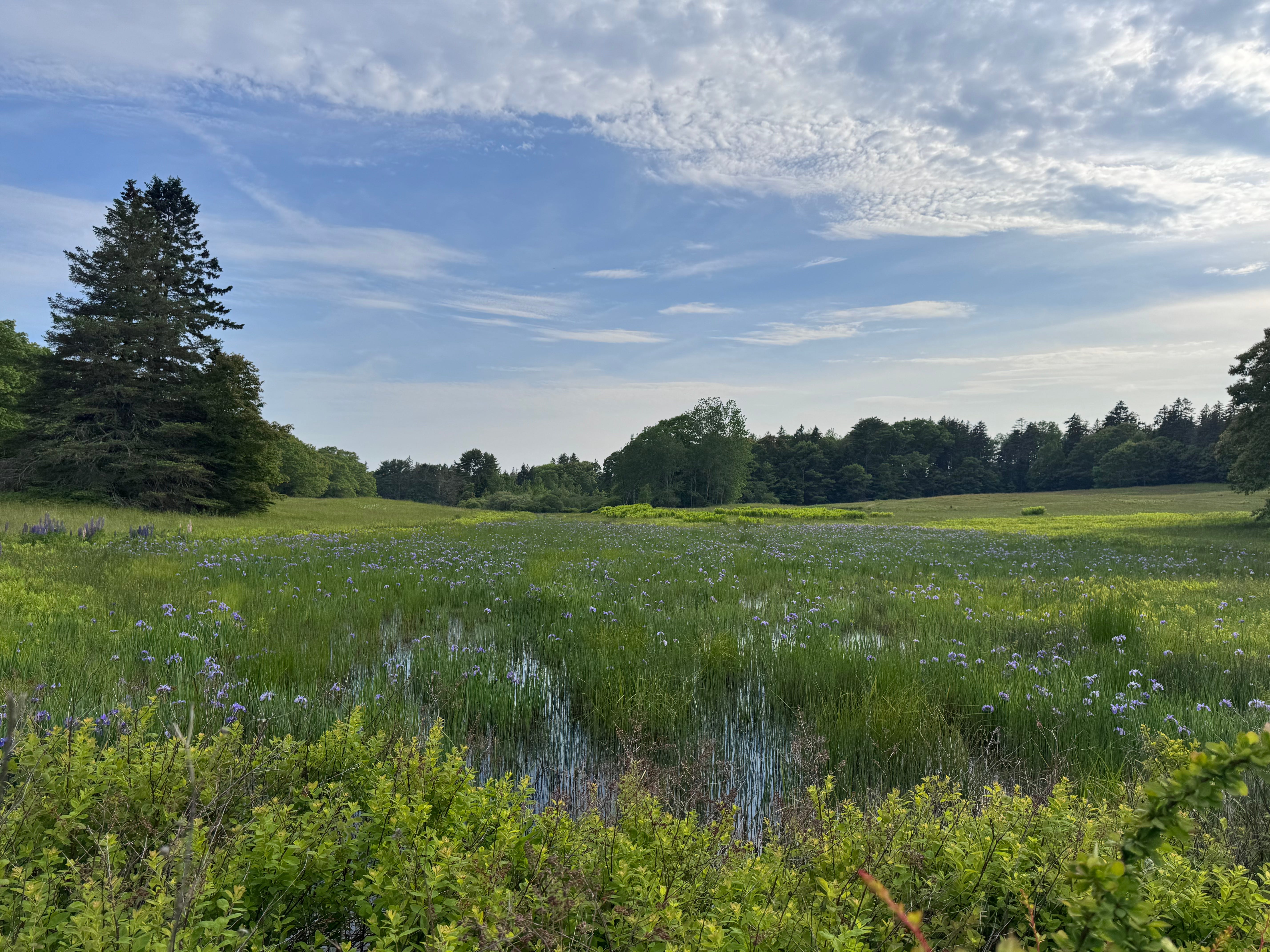
And just like that, it’s spring in the Midcoast. Nearly summer, in fact. The bobolinks are nesting and so are the ospreys. Pollinators are hungry and searching for food, and alewives are making their improbable journey upstream. In this issue we look at some of the other harbingers of spring in Maine — an iconic native tree, a butterfly that hibernates, a bird more often heard than seen, and the snakes that call Maine home.
See you outdoors,
Rob Smith, Ted Piccone, Deb Morgan
Wildflowers with Wings
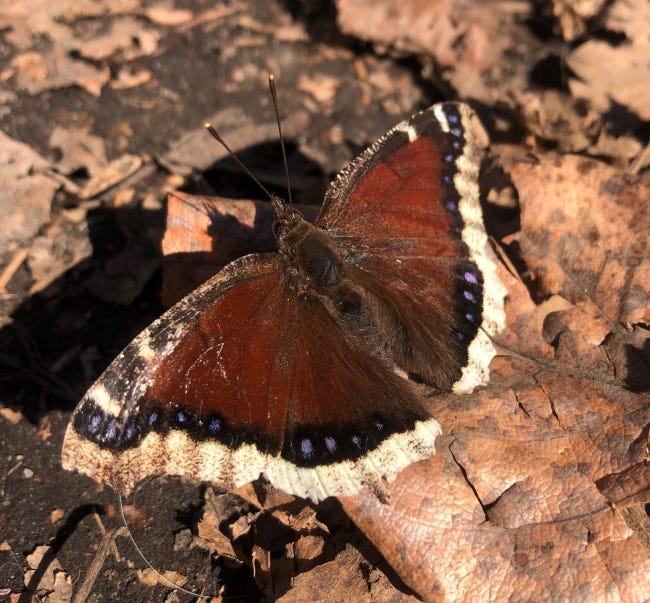
A full-fledged butterfly that “freezes” for the winter and flutters about again in early March? Meet the Mourning Cloak!
Most early signs of spring’s arrival in Cushing are considered “new” — the growth of rose-hued bud breaks on the tips of our red maples, or the first appearance of resident birds that decamped to our South like phoebes and osprey. But my hat’s off to those outwardly fragile creatures that never left, but reappear seemingly out of nowhere on a warm day in late March or early April. They have adapted to winter survival as is, no matter how long or cold the season. A particularly noticeable species that overwinters in adult form is the mourning cloak (Nymphalis antiopa) — a large butterfly with velvety, dark maroon wings edged with yellow and rows of iridescent blue spots. On a warm sunny day (if there is one!) in March or April, you may see a mourning cloak sunning with wings open on a rock, or flapping about the trees. They are the first ones out and about at the earliest hints of spring (this year I first spotted one in Cushing in early May). These butterflies are already fully formed because they actually get through the winter as adults hunkered down immobile under tree bark or in other protected niches. But once the temperature rises, they spread their wings and come to life. By emerging in early spring before most insects are out, they avoid — at least for a time — predatory dragonflies and many insect-eating birds which are still making their way north. When they close their wings, they blend into the brown bark of trees. But their defenses may be even more elaborate: when threatened, mourning cloak butterflies can pull up their legs, close their wings, and topple on their sides, motionless, simulating dead leaves.
How do these ephemeral creatures make it intact through our harshest Cushing winters? They load up on sugar in late summer and fall and then go into diapause, an insect version of hibernation. In winter, they appear to freeze, but their living cells remain unscathed due to the presence of a natural anti-freeze chemical called glycerol. This form of alcohol lowers the freezing point of water, allowing the cells to supercool without destructive ice formation. Because of stores of glycerol, mourning cloaks can withstand temperatures well below zero degrees.
Their emergence in spring also precedes most flowering plants, so mourning cloaks will frequent trees with available sap from winter bruises on oaks or maples or where a woodpecker’s drill has opened up a wound with a nutritious ooze. They are generalist feeders, getting nutrients from decaying apples that soften after a thaw, or virtually any softening organic debris.
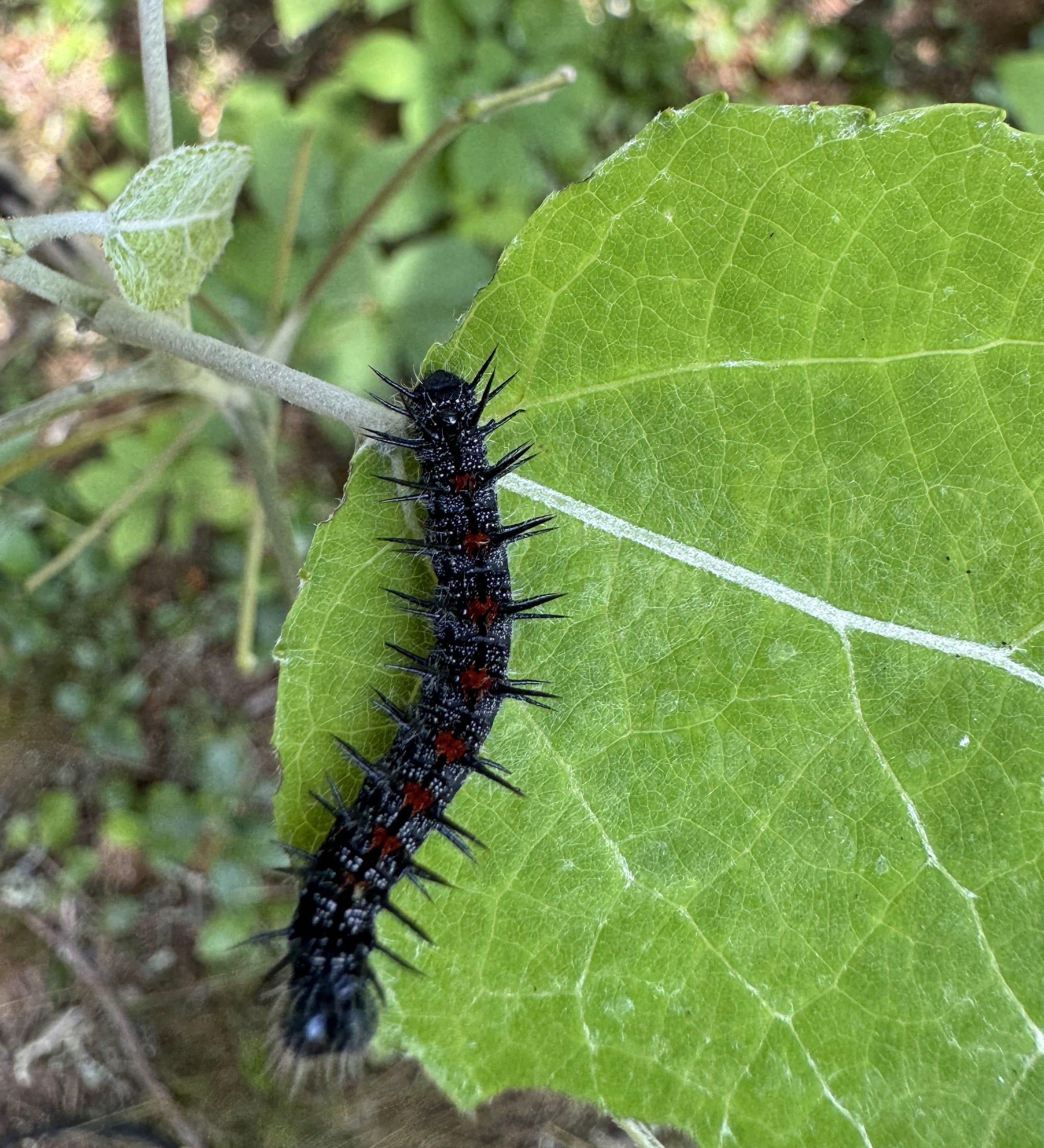
Mourning cloak adults will breed in late May or June before dying. Males are territorial and will sometimes perch high in trees to ward off intruders while awaiting a female to flit by. By the time they mate, they will be the Methuselahs of the butterfly world, having lived to the age of 8-10 months or even more (most other butterfly species live for only a couple of months). Mourning cloak females will lay eggs in clusters of up to 50 on leaves or bark. These eggs will develop into black caterpillar larvae that ball about feeding on the leaves of favored trees such as willows, elm, aspen, birch, and serviceberry. Fully grown caterpillars have a row of orange dots along their black torsos which are spiked with black hairs and stubby reddish legs (this coloration may signal danger to some avian predators). While some pupate in a gray chrysalis until late summer, others emerge from the chrysalis in July and continue to develop into newly fledged adults that aestivate (lay low) before foraging again in late summer.
Other spring butterflies found in Cushing and nearby islands
There are seven other species of butterflies that overwinter as adults in Maine. These include the colorful “tortoiseshells” (Milbert’s and Compton) and the aptly named (for the pattern on their underwing) comma butterflies. A few of these species may be seen in Cushing, but are less common and less noticeable than the mourning cloak.
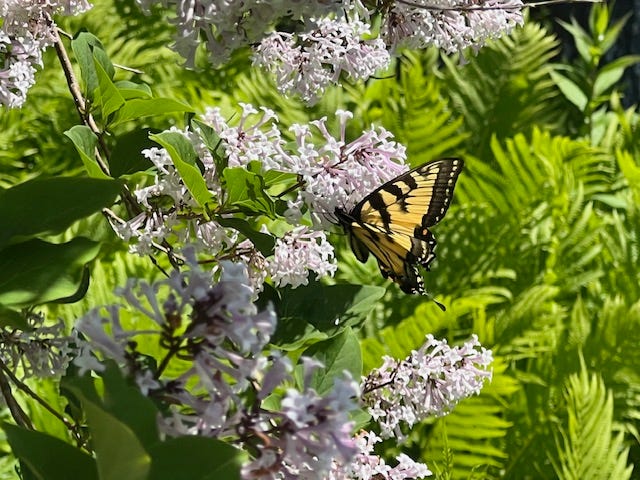
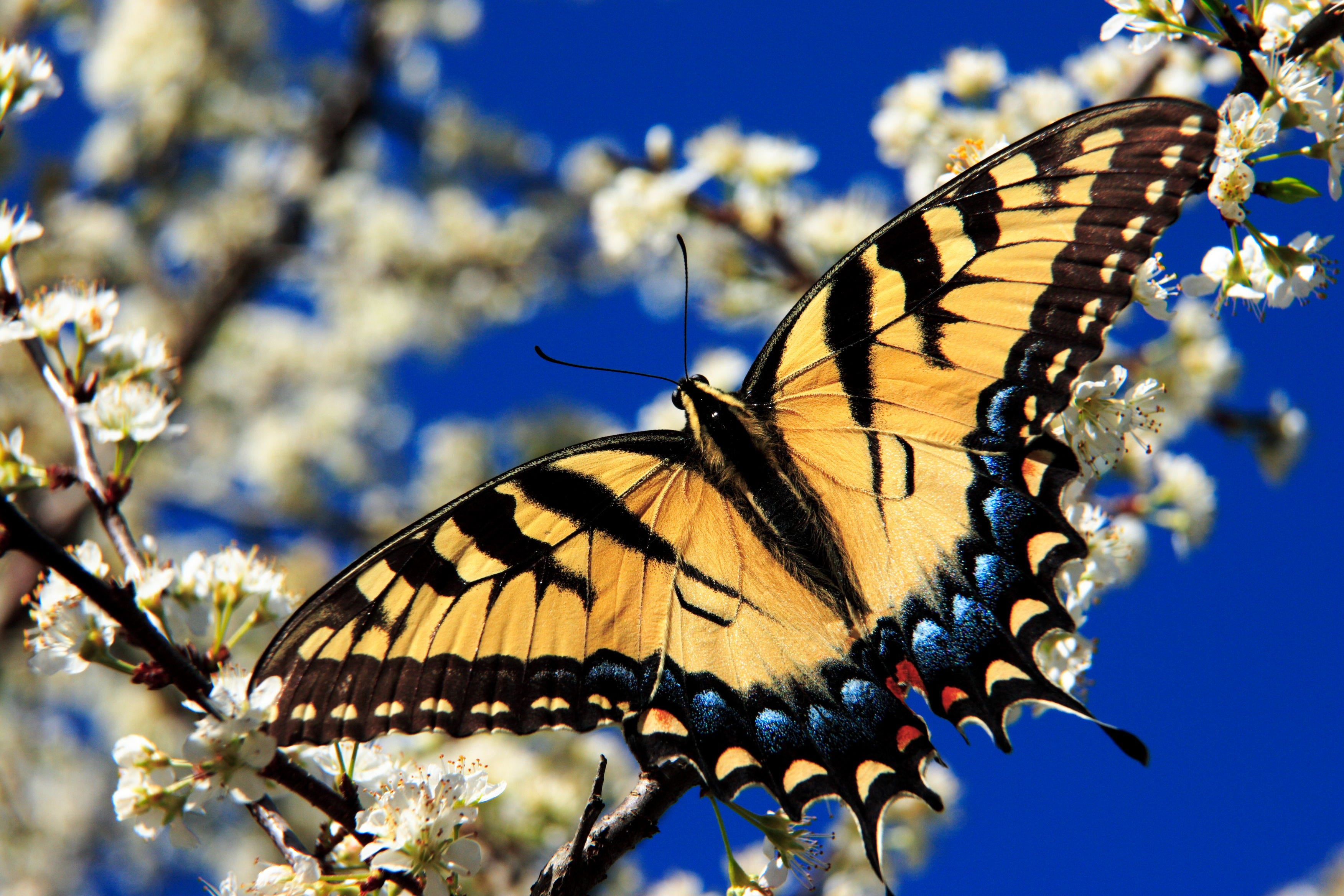
Then there are butterflies that survive the winter as pupae. Often first seen in May, the Canadian tiger swallowtail (Pterourus canadensis) spends the winter in a nondescript pupal stage where it lies dormant within a protective chrysalis. It is ready to emerge as warmer days begin. Tiger swallowtails are common and highly visible species from May into July in most habitats on the Cushing peninsula. They feed as adults on nectar from up to 80 different flowering plant genera (including serviceberry, as seen in an article below). Their “tails” may aid evasive flight, and serve as a decoy for aerial predators on their trail. They mate soon after emerging, lay eggs and die within a few weeks. Chokecherry (Prunus virginiana) is a preferred host plant for this butterfly and its caterpillars.
Another winter survival strategy, of course, is to head to a warmer environment and move north again in spring, as do the famous monarchs (Danaus plexippus). Monarchs are not the only species that migrate long distances to Cushing from the south, however. The American lady (Vanessa virginiensis) and its highly cosmopolitan cousin, the painted lady (Vanessa cardui), are intermittently common on the Maine coast in spring and summer, and regularly seen in Cushing. American lady butterflies are summer residents throughout North America, but move south by late fall. Painted lady butterflies actually fly thousands of miles from the Southwestern US to the East Coast. Even more amazing, some populations of this species regularly cross the Atlantic Ocean in a 4200 km flight from West Africa to Brazil.
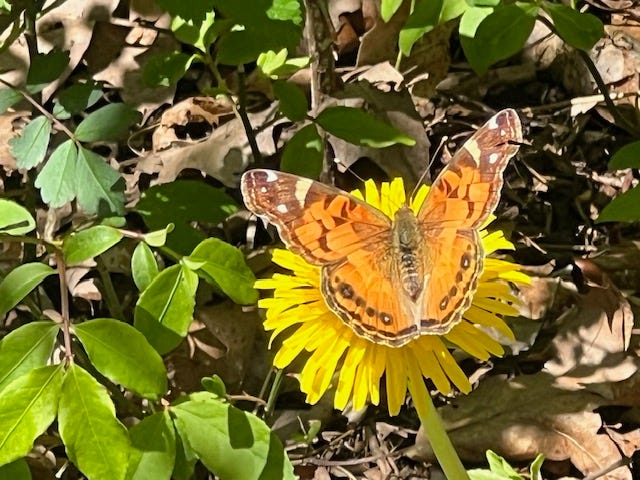
Our varied coastal habitats and adjoining islands may host a surprising number of Maine’s butterfly species. A study by Ernest Wilson of butterflies seen on Monhegan Island from 1998 to 2018 yielded 40 different species, over one third of the butterfly fauna recorded in Maine. About 27 species appeared to be residents, and another six species reach the island every year from migration. The mourning cloak butterfly and three migrants (monarch, American lady, painted lady) were among the commonly observed species. Given that habitats are more varied in Cushing, it is likely the total number of species that flourish here is even higher.
What does the future hold for our “wildflowers with wings”?
We are fortunate to live in a time when we can easily see many of these butterflies in our backyards right here in Cushing. But data from around the planet is not encouraging. More studies now document rapidly declining insect numbers from large areas of Europe and North America. A recent report in Science concluded that butterfly declines of over twenty percent had occurred in the US in just the past two decades and involved most of our species.
Many biologists are amazed at how rapidly the losses happened and yet went largely unnoticed. The likely causes are multiple, with habitat loss and expanded use of more potent insecticides leading the list. Climate change is another stressor. Losses were most pronounced in the Southern and Midwestern US, and particularly in areas with prolonged drought. Maine is buffered to some extent by its varied habitats and extensive rural landscapes, but declines are occurring here as well. Fields that once hosted varieties of wildflowers throughout the summer are tempting targets for real estate development, whether residential or commercial. Non-native invasive plants have overtaken many landscapes, pushing out the native plants that butterflies and their caterpillars depend upon to survive. Pesticide formulations since the 1990s may include neonicatinoids (“neonics”), chemicals that disrupt insect nervous systems. They are water soluble and not only persist in the terrestrial and aquatic environments but are integrated into plant tissues, including pollen and seeds. Recent studies have detected neonics in multiple surface water sources, including rainwater. Restrictions on the use of neonics in Maine are outlined by the Maine Board of Pesticides Control, and generally limit use to licensed applicators.
Climate change, of course, is already universally underway, disrupting the timing of plant blossoming for pollination by some insects, and posing a particular threat to migratory species like monarchs and American lady butterflies. The truly cumulative impacts of climate instability loom on the horizon. Entomologist David Wagner describes the cause of insect declines as “death by a thousand cuts.” While this may sound like another message of “doom and gloom,” it also gives a nod to the fact that there is much we can do to counter or mitigate the stressors on our insect pollinators. Butterflies embody more complexity — and resilience — than we might think. Creation of better habitat on a local level is relatively simple and cheap: remove non-native, invasive plants from your property, and add straight species native plants (rather than cultivars which don’t offer the same benefits to pollinators). Eliminating unnecessary insecticide use — or at the very least, choosing less harmful chemicals — can have immediate benefits.
If you like seeing butterflies, spice up your lawn with patches of flowering plants that butterflies will frequent. Consider tolerating a lawn with 4-6 inches of growth rather than recreating you own putting green week after week. Avoid the use of insecticides. Then start looking and enjoying what you are creating in your own backyard. It may not take long for you to see a changing cast of “wildflowers with wings” over the summer and into fall. If you want to learn more, see the resources listed below. And for those with a hankering to know our Maine gallery of butterflies better, I highly recommend Butterflies of Maine and the Canadian Maritime Provinces by Philip deMaynadier and others. You can also add to our local knowledge of species present by acquiring an iNaturalist app — it allows you to identify what you see while providing a digital record of the species present on the Cushing peninsula.
Let’s look again to the mourning cloak as both a biological wonder and a symbol of hope. Its survival strategy appears successful, as this species is present in good numbers throughout North America and much of Europe. In the UK, where it is not a resident species and quite rare, it became known as the “Camberwell Beauty,” due to its first sighting in the 18th-century in a village of that name just outside of smoky, industrialized London. In North America, the butterfly’s early spring activity and its somber but lovely wing coloration led to its depiction as a metaphor for resilience and hope following grief or the darkness of winter. And so far, mourning cloak butterflies have proved to be resilient. So keep an eye out for mourning cloaks now and into the fall. If you see one then, imagine that lone insect re-emerging intact and ready to go next spring — no matter how hard the winter!
Resources for Additional Reading
Coverstone, Nancy, et al. Landscaping for Butterflies in Maine.
University of Maine Cooperative Extension Bulletin #7151, 2003.
DeMaynadier, Phillip, et al. Butterflies of Maine and the Canadian Maritime Provinces. Cornell University Press, 2023.
Maine Butterfly Survey. University of Maine Farmington, 2006-15 (updated 2022). https://www.maine.gov/ifw/fish-wildlife/wildlife/species-information/invertebrates/butterfly-survey.html
Wilson, Ernest H. “The Butterflies of an Isolated Island: Monhegan, Maine.” Northeastern Naturalist, 26; July 2019; 26 (3): 537.
- Rob Smith
Behold the Snakes of Maine
One day as I walked down our driveway in Cushing with a local arborist — a brawny woodsman and part-time security officer — he suddenly shouted and jumped out of the way of a slithering snake. It reminded me of the time my wife came upon a large snake coiled up on our kitchen floor in DC, and with relief watched it slink away under the refrigerator, never to be seen again.
Deep down in our “reptilian” brain we harbor a fear of snakes, a predilection widely reinforced on screen and off. But when it comes to the herpetofauna of Maine, there is no need to worry. Our local snakes are non-poisonous and signal a healthy ecosystem able to support these quiet and reclusive creatures.
In my walks through the woods and weeding in the garden on Davis Cove, I have been fortunate to come across at least two or three of the nine species known to inhabit Maine’s lands and waters. I say fortunate because snakes are highly beneficial to our biodiversity: they consume rodents and other pests that may otherwise get into bird nests or our pantries, aerate soil, and maintain a balanced food chain in our surroundings.
These serpentine creatures come in many different colors, patterns and lengths, even within the same species. So identifying them can be challenging, particularly since they are generally shy and avoid human contact. The Maine Department of Inland Fisheries and Wildlife (MDIFW) invites the public to help identify snakes in their local areas by filling out a quick survey and, if available, sharing a photo. The free app iNaturalist is another good option for sharing your finds with a wider community of folks interested in understanding our natural environment.
Here are a few snake species you might come across in your backyard:
Eastern Garter Snakes (Thamnophis sirtalis sirtalis) are the most common snake species in Maine and can be found in a variety of settings from woodlands to marshy waterfronts. They typically give birth to anywhere from 4-20 live offspring from July to September and survive our cold winters by entering a state of dormancy known as brumation. They hibernate with other snakes below the frostline in sheltered rodent burrows or ant mounds known as hibernacula, then re-emerge in spring. Earthworms and slugs make up a majority of their diet, but they also consume rodents, amphibians, and even small birds. They also enjoy a good sunbath.


The Eastern Garter Snake typically has yellow or orange stripes against a checkered darker background, making it hard to distinguish it from its cousin, the Eastern Ribbon Snake (Thamnophis sauritis). The Ribbon Snake’s yellow stripes are creamier than that of the Garter, and they have a very specific white marking in front of their eyes that Garter Snakes lack. In Maine, Eastern Ribbon Snakes are designated a species of “greatest conservation need,” which according to MDIF&W’s State Wildlife Action Plan means species that are “either intrinsically rare to Maine, are experiencing population declines, or represent important stewardship responsibilities for the state.” As of the end of 2024, they are separately listed as a species of special concern due to their rarity in Maine. This species lives mostly in wetland areas where they happily eat frogs and salamanders as well as insects and small fish and are quick to hide from human contact.
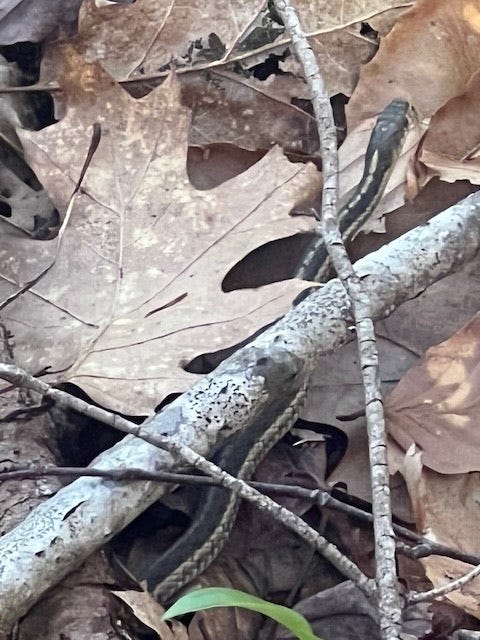
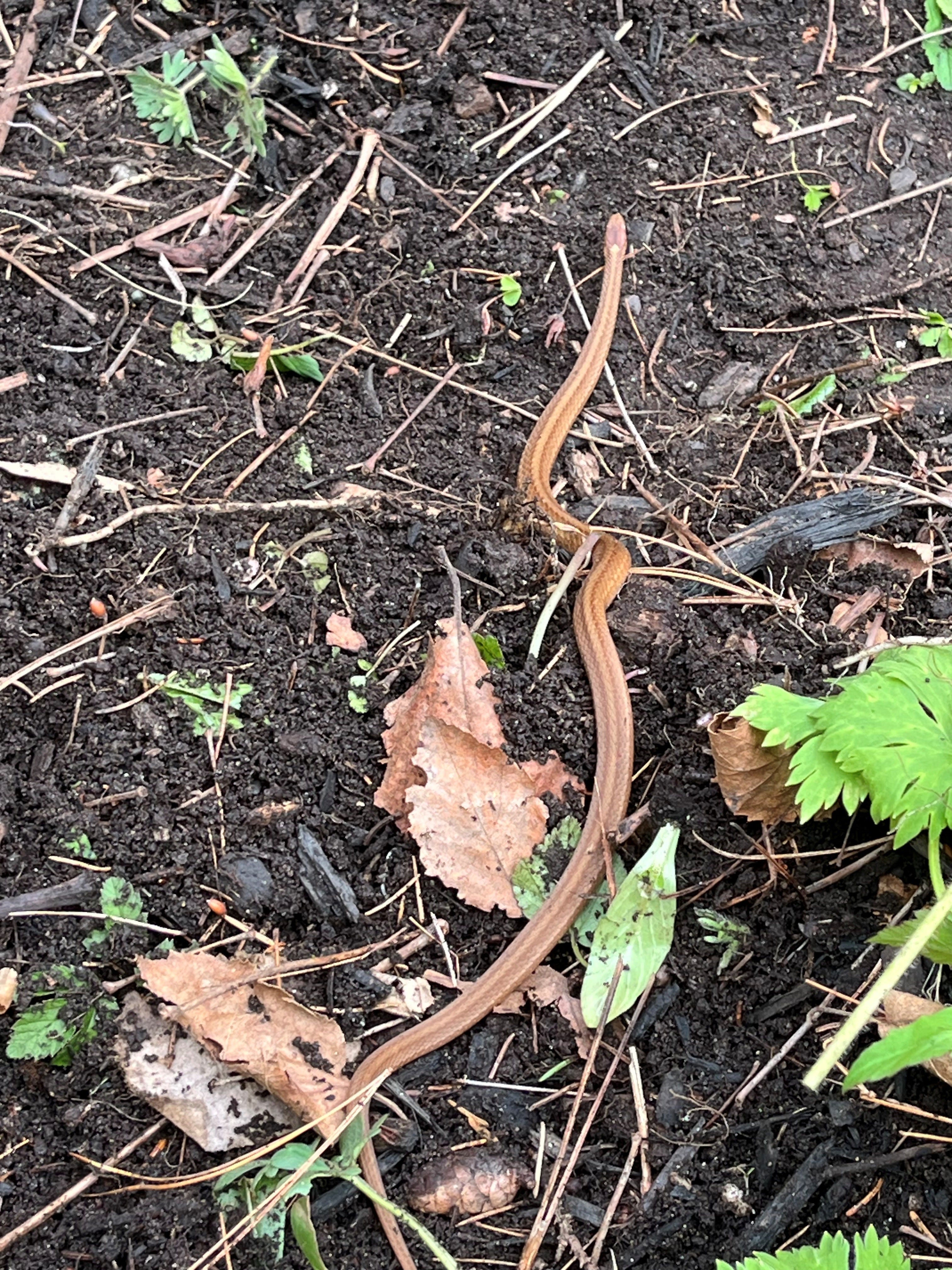
Another relatively uncommon snake is DeKay’s Brown Snake (Storeria dekayi dekayi), a smaller variety that blends in well with leaf litter or compost in your garden before darting to a stone wall or undergrowth. Like Garter and Ribbon Snakes, they are viviparous, meaning that they give birth to live offspring instead of eggs. Their diet consists mostly of earthworms and slugs as well as insects and small frogs. They are listed by MDIFW as a species of greatest conservation need here in Maine.
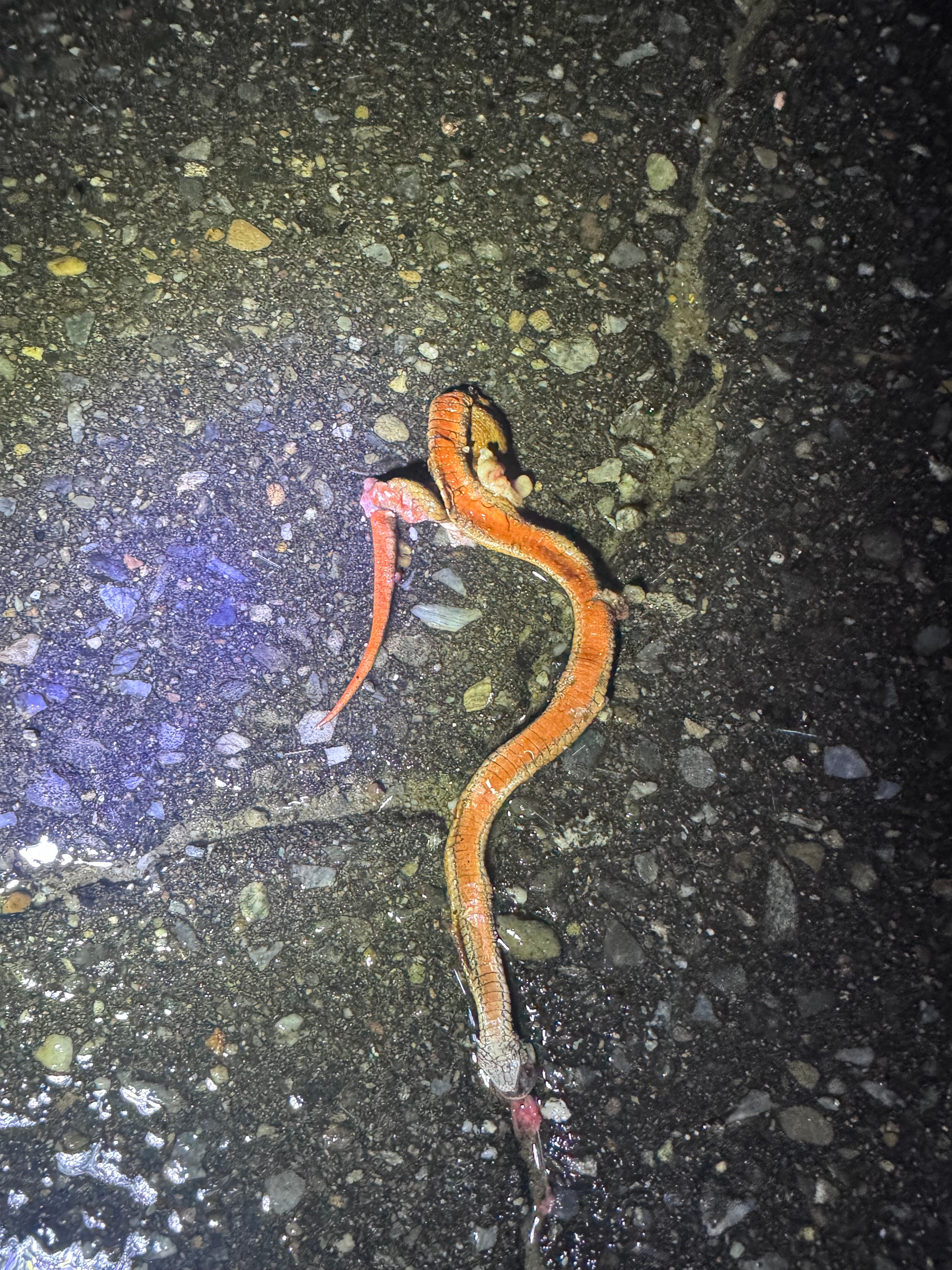
Conservationists believe that while raptors, raccoons, and other predators manage to consume their share of our local snake populations, fragmentation of their habitat is a growing concern. As they search for food and secure habitat, they often cross roads that leave them exposed to our four wheels. As Deb Morgan reported during a Maine Big Night watch this spring, a Red-bellied Snake (Storeria occipitomaculata) in Owls Head ended up as road kill, along with many frogs and salamanders making their annual trek to spawn in vernal pools prevalent in our area.
Snakes appear to move in mysterious ways but when you get close enough to check out their scaly skin you can get a better understanding of how they do it. Our Maine snakes mostly use the classic S-shaped movement, known as lateral or serpentine undulation. This involves using a series of internal muscles to shift their weight along a set of points in their bodies. They then use their keeled belly scales to push off against the surface to generate forward motion. Another common motion used by Garter Snakes, known as concertina locomotion, is deployed when climbing or navigating rough surfaces. This technique works by extending the front part of the body forward, anchoring it, and then pulling the rest of the body up by coiling it into S‑shaped curves. When they are ready to strike, they wrap themselves up and lunge with their heads at hyper-fast speed.
No need to worry, however, about that happening to you around these parts, as long as you don’t harass the animal. If you do come across one on your path, simply stop, give it a wide berth, and leave it alone. On rare occasions a mishandled Garter Snake may try to bite, but they only release a mild, harmless venom or a musky odor to ward you off.
- Ted Piccone
They’re Baaack…
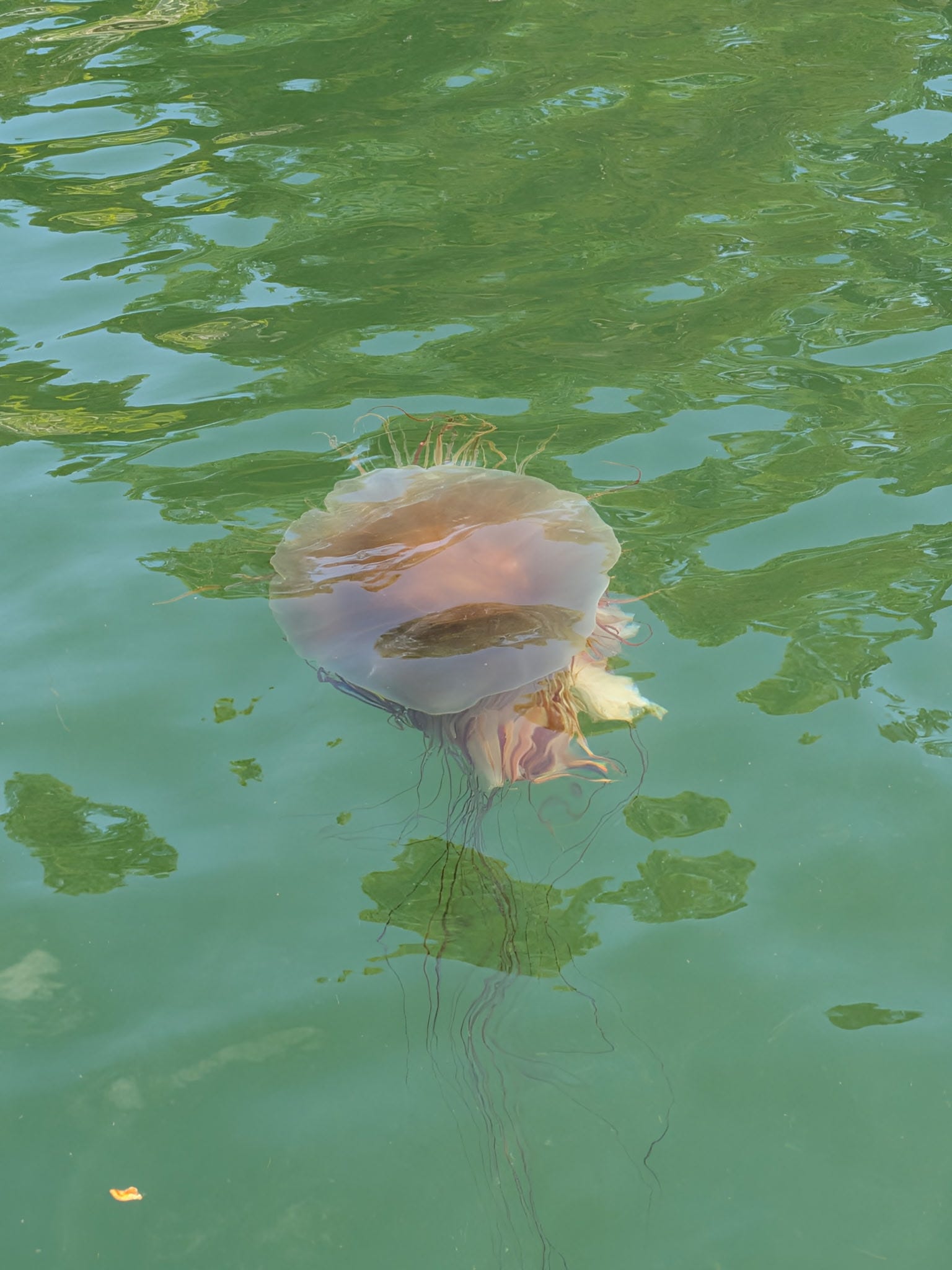
Remember the lions mane jellyfish that took over Maine’s coastline last summer? They’ve been spotted again. An almost five-foot wide specimen on Lincolnville Beach made the news last week, and Rob’s son photographed a smaller one in Davis Cove on May 30. To learn more, see the November 2025 issue of Backyards & Backwaters.
Amelanchier: A Keystone Plant by Any Name
Ethnobotanists know that the more names a plant has, the greater its cultural value.
- Robin Wall Kimmerer
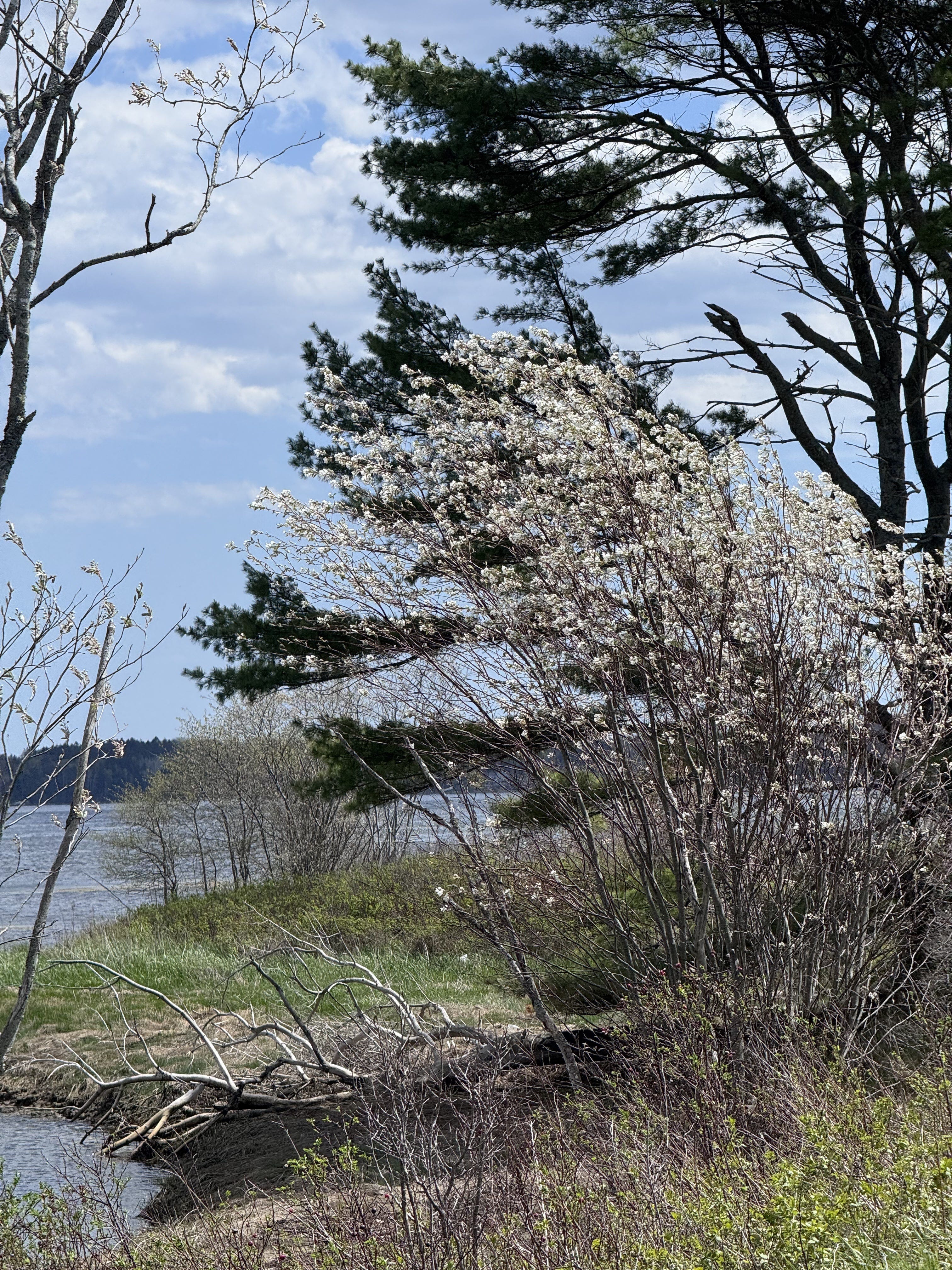
Serviceberry. Shadbush. Shadblow. Saskatoon. Juneberry. These are just some of the common names for a genus of small trees or shrubs called Amelanchier. This long list of names tells us these trees have been prized over the centuries by indigenous peoples and North American settlers. They are a calendar plant — their early flowers indicating a change in season and a time for particular activities like hunting, harvesting, or fishing. In some regions, they were known as shadbush or shadblow because they flowered around the time when shad fish made their way upriver to spawn. Those who looked forward to the month when the fruit came ripe called them Juneberries. In New England, the name you hear most often is serviceberry, so-called because the flowers appeared when the ground was fully thawed, allowing graves to be dug and funeral services conducted for those who had died over the winter.
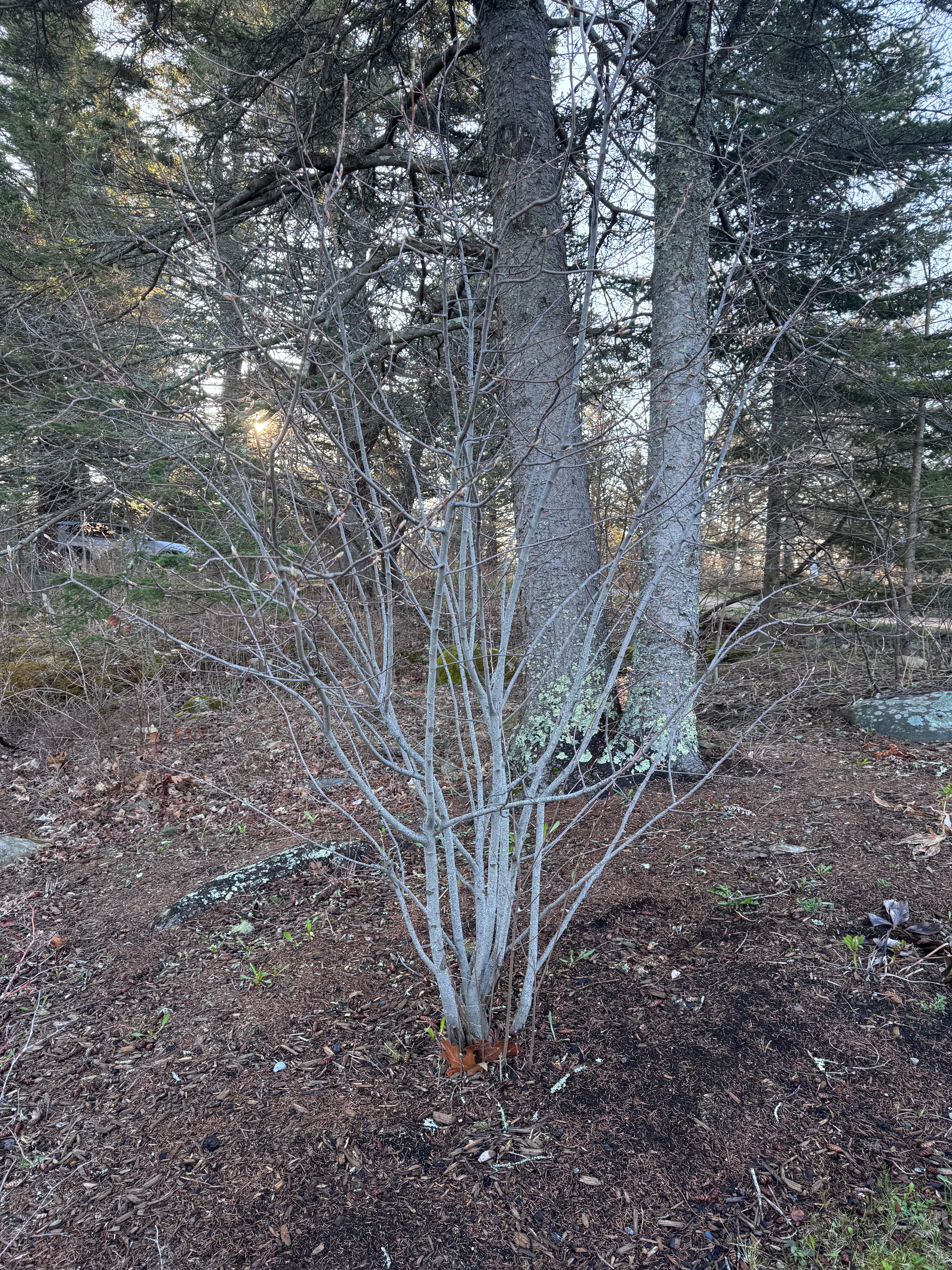
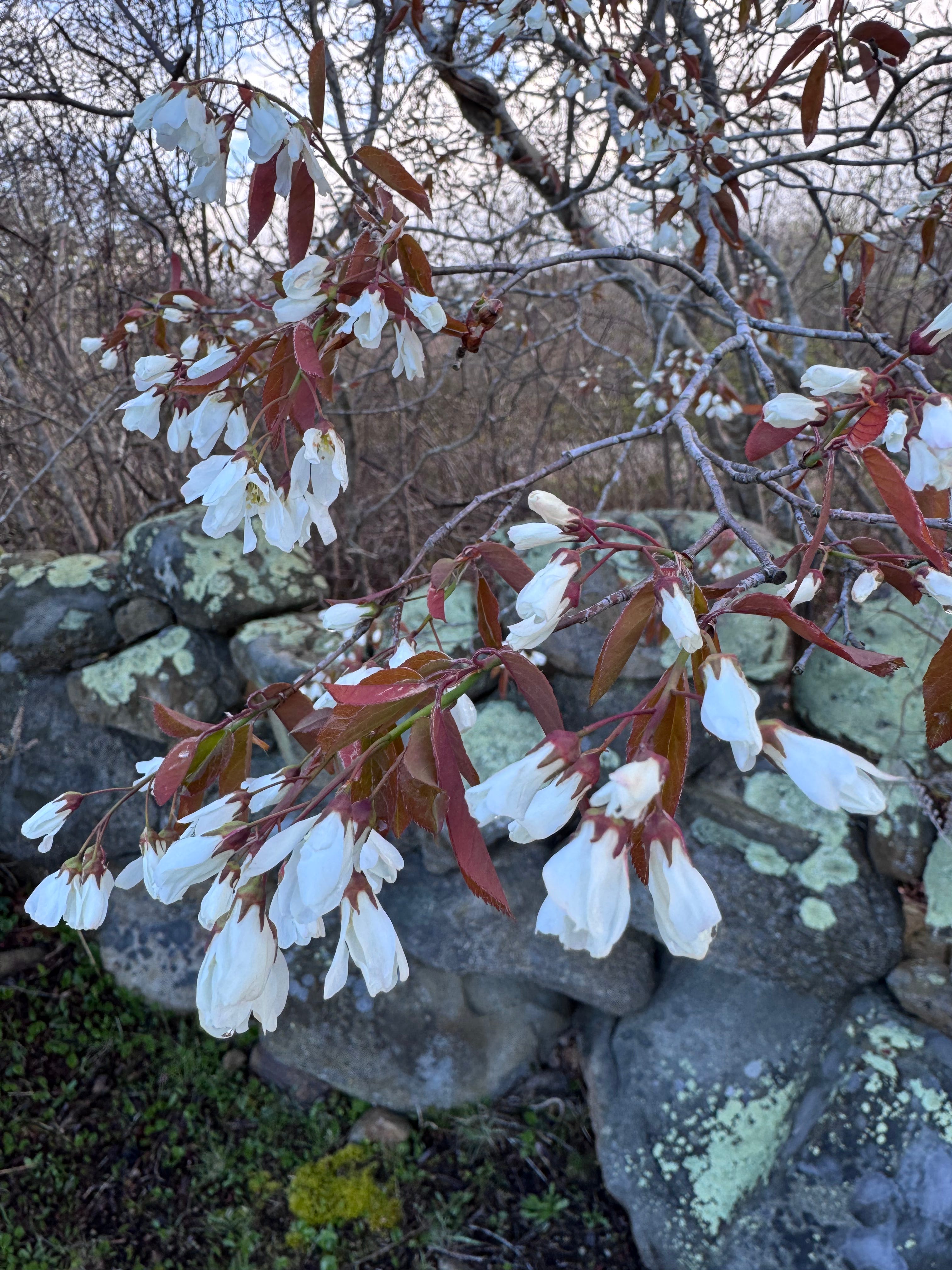
There are over 20 species of Amelanchier throughout North America, and they appear in the wild in every state except Hawaii. Here in Maine, we have about seven species, but the two we see most commonly in our area are the Allegheny serviceberry (Amelanchier laevis) and downy serviceberry (A. arborea). The young leaves of the Allegheny are a rich bronze — a beautiful backdrop for the nodding, white flowers — and they reputedly bear the tastiest, juiciest fruit. The downy serviceberry gets its name from the fine white hairs on the underside of new leaves. Like most of the genus, they’re happy in almost any type of soil in a full or partly-sunny location and, while they sometimes take on a shrubby form, they usually grow as a multi-trunked tree with light gray bark and a rounded canopy, ranging in height from 15 to 30 feet when mature.
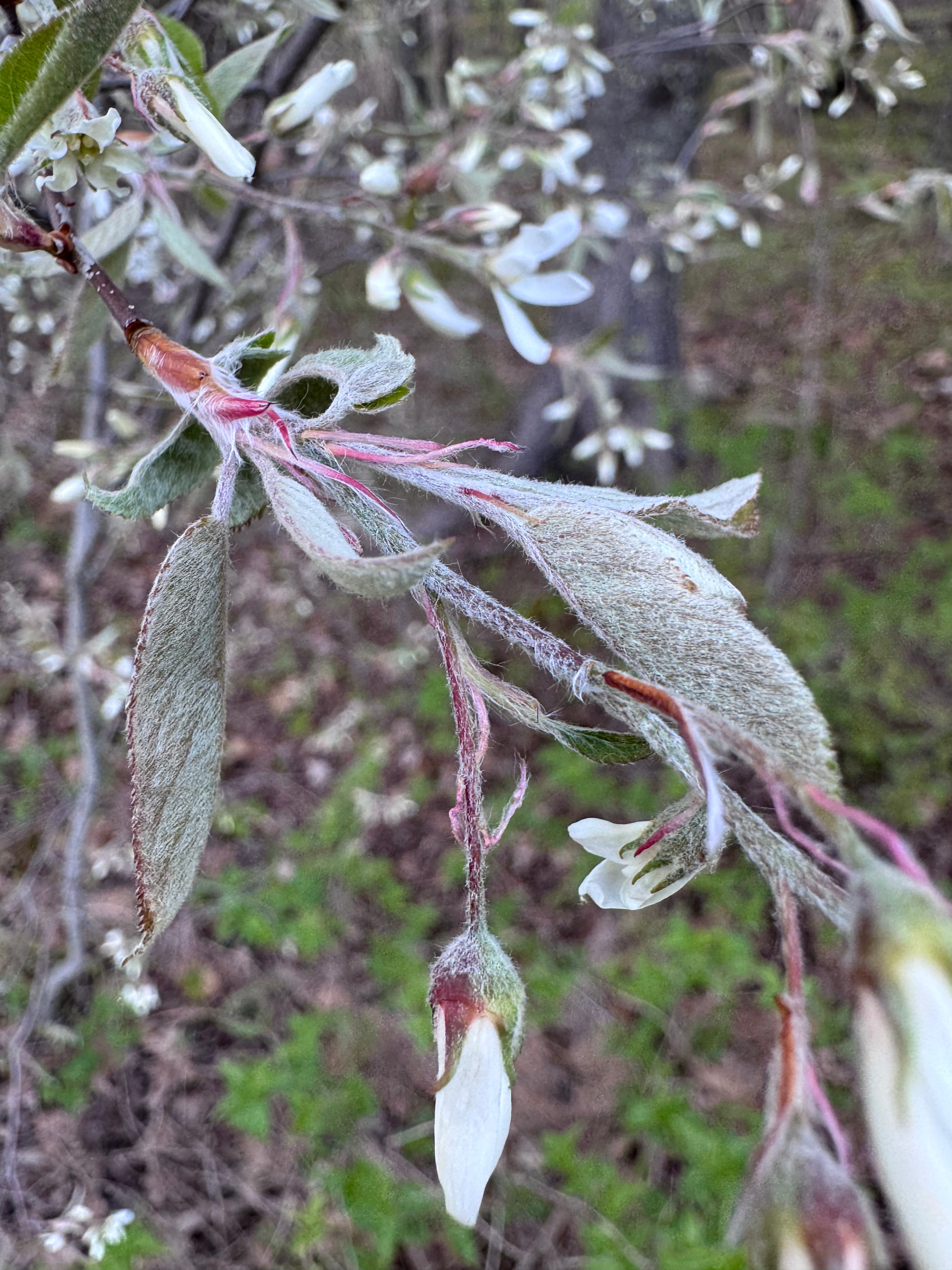
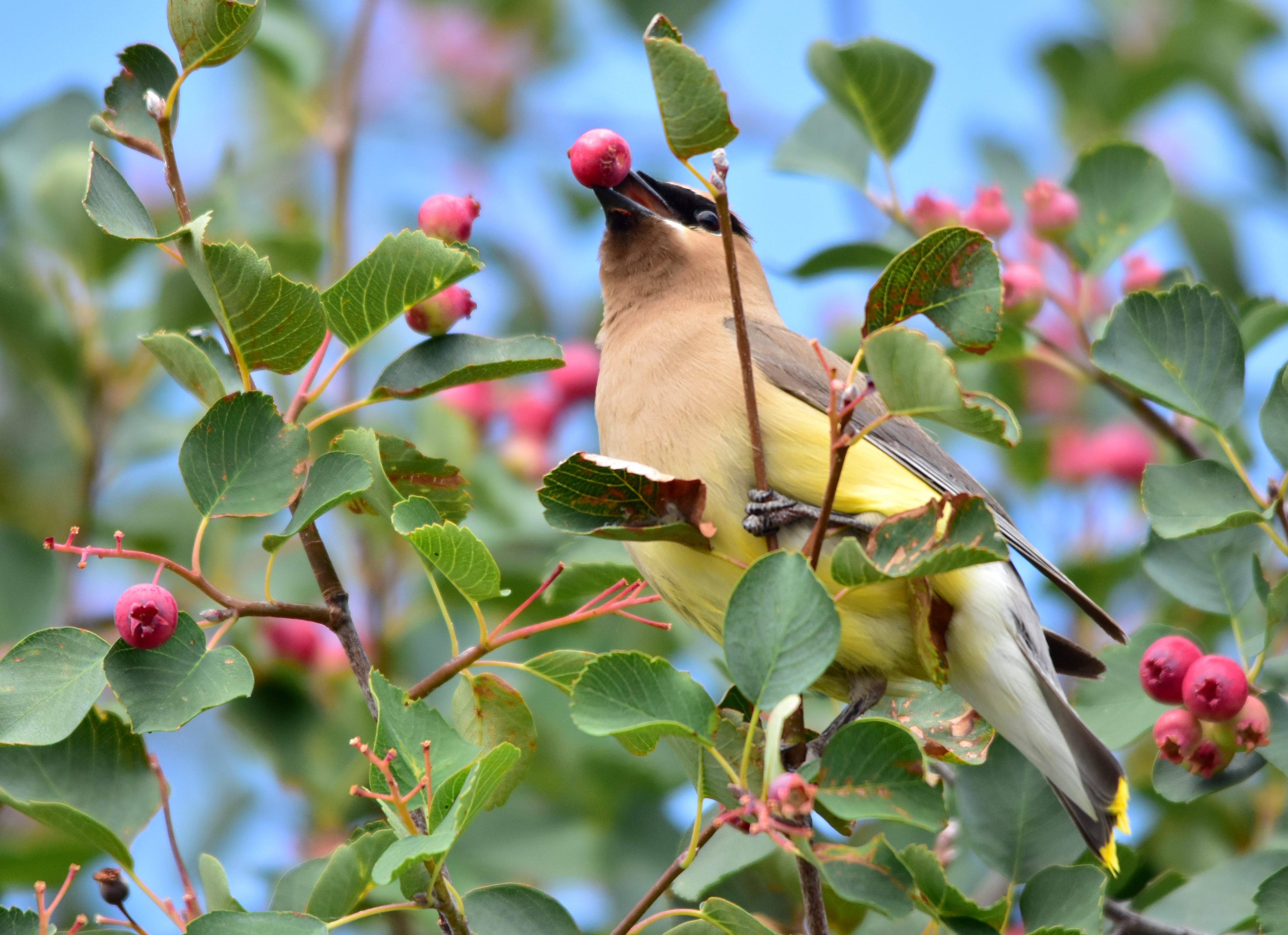
The blooms are past now, but in mid-May our local serviceberries were in full bloom along roadsides, stream banks, and at the edge of woodlands. Their frothy white flowers really stand out when the rest of the landscape is still looking pretty drab. Among the most common trees in Maine, serviceberries are considered a “keystone plant” for our ecoregion, meaning that they are an essential native plant supporting a disproportionately high number of wildlife species. Their flowers are an early source of nectar for many pollinators and they serve as a host plant for a variety of insects, including the caterpillar form of the Striped Hairstreak and Viceroy butterflies, as well as the Canada Tiger Swallowtail butterflies that Rob mentions in another article in this issue. Later in the summer, the berry-like fruit is devoured by waxwings and other birds (roughly 35 species in all), along with mammals like chipmunks, squirrels, raccoons — even beaver and bear.
The fruits are generally underutilized in our region today. Shaped like a blueberry and similar in taste (with a hint of almond from the seeds), they can be eaten straight off the tree, baked into pies or muffins, or cooked into jam on their own or mixed with other berries. There is a trace amount of cyanide in the seeds that could cause diarrhea if you eat an enormous amount of fresh berries, but there are no reported cases of this (cooking removes the cyanide, so go ahead and have a big slice of serviceberry pie). The fruits start out green and change to red, but are at their peak and taste sweetest when they turn a dark purple. Loaded with vitamins A and C, they’re also a good source of many minerals including magnesium, iron, and calcium. The Wabanaki and other tribes knew their value, eating them fresh as well as mixed into the original protein bar, pemmican. Made of dried, powdered meat mixed with dried berries and rendered animal fat, pemmican was a portable, calorie-dense food with a long shelf-life, ideal for travel and making it through the long winter.
Serviceberries tick a lot of boxes for the home gardener: early spring flowers, edible fruits, and gorgeous fall leaf color. Their small size make them easy to incorporate as specimen trees or in a mixed border of trees and shrubs. I have an Allegheny specimen in a small border, underplanted with ferns and other perennials. This summer I plan to try the fruit for the first time, if the birds don’t get there first.
- Deb Morgan
The Woodcock: Sky Dancers of Spring
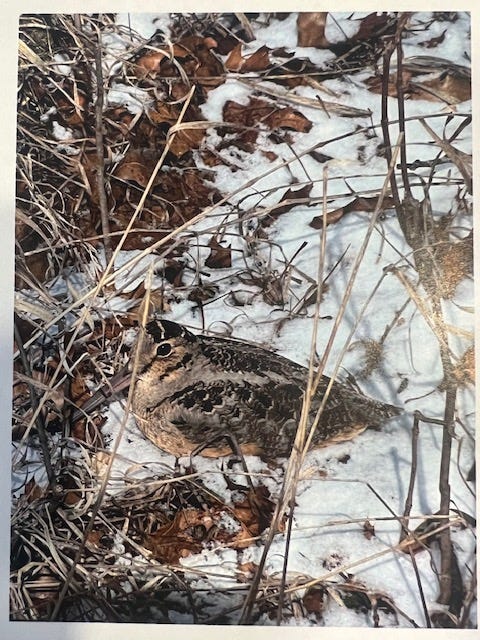
The American woodcock (Scolopax minor) — aka timberdoodle, night partridge, Labrador twister— is unusual in more ways than their oddball appearance. The Wabanaki term for woodcock translates to “underleaf bird”, which characterizes their usual behavior. They are sandpipers that live in forested upland areas as well as boggy meadows. They feed predominantly during the day but also at night in summer, and are nocturnal foragers in winter. Their preferred diet is earthworms, for which their long bill with flexible upper mantle is well adapted for delicate extraction. These bills leave telltale marks in the soil called “borings.” Their eyes are large, widely spaced and sit back a bit on their heads, affording a 360-degree view of predators coming from above. Though small and stubby, woodcocks are highly treasured as game birds. They are generally reclusive, seen only when flushed on a meadow walk or by a dog on the hunt. Then they suddenly erupt from underfoot and fly up and away with a whirring of wings before dropping back into cover.
The exception to their secretive behavior is what Aldo Leopold called a “celestial dance” — their spring mating ritual. These sky dances can occur almost anywhere in Maine where there is an open section of meadow with some cover. But you have to time your March to mid-May viewing just right. The dance starts at dusk (or sometimes dawn), and continues on in the dark for 30 to 60 minutes (unless the moon is full, in which case it may repeat long into the night). It is announced by a loud robotic “peent” sound that has been likened to the zap of a bug buzzer. The male repeats the call as he pivots in a tight circle to broadcast the upcoming show to any females in the area. The subsequent magic we viewers experience derives from a mix of strange and intriguing night sounds coupled with the shadowy forms of birds ascending in a wide spiral toward the stars before plunging earthward, all the while emitting a long twittering whistle. Each flight lasts about 40 to 60 seconds. As Ora Knight in his Birds of Maine (1908) described it:
“Late in April, or early May visitors to the swampy woods at evening dusk may hear a strange “peep-peep” sounding from the depths of gray birches. Then, without other warning a strange bird (to them) springs up from the birches in ascending spirals with whistling wings. Finally reaching the limit of flight at 200 to 300 feet, he descends headlong and zigzags with a clear twitter of whistling melody — a love song.”
When our family first moved to a suburb outside of Portland in the 1980s, I was surprised to find woodcocks displaying in a weedy lot next door. This display continued each April for several years, and then the woodcocks no longer appeared. Given that it was a neighborhood with a number of young children, dogs and cats, it was a surprise to me that woodcocks were there to begin with. But it’s likely that site had been favored for many decades until our human presence became just a bit too much. Though you may occasionally flush a woodcock while hiking, the best chance to see one, or its shadowy silhouette, is during their mating display. It’s easy enough to experience if you know where to look and allow some time to listen for the distinctive “peents.” Deb Morgan has seen woodcock at the southern end of Pleasant Point, and there are many other areas of Cushing that are ideal habitat for this species. In mid-May, I witnessed the display from the field by the lighthouse on Monhegan Island. The birds were, as expected, hard to see after dusk with only a sliver of a moon. The regular sweep across the forest from the lighthouse distracted a bit, and the birds’ twittering flight song had to compete with the island’s generator. Nevertheless, our group of observers watched in a reverential hush as we listened and traced the shadows of birds doing their best to attract a mate in front of a human audience.
Following their courtship displays, woodcock make a nest at the base of alders, aspen, or birches within a meadow or on the edge of woods. They typically produce 2-4 eggs which hatch by May, and within a month or so the young can fly well enough on their own.
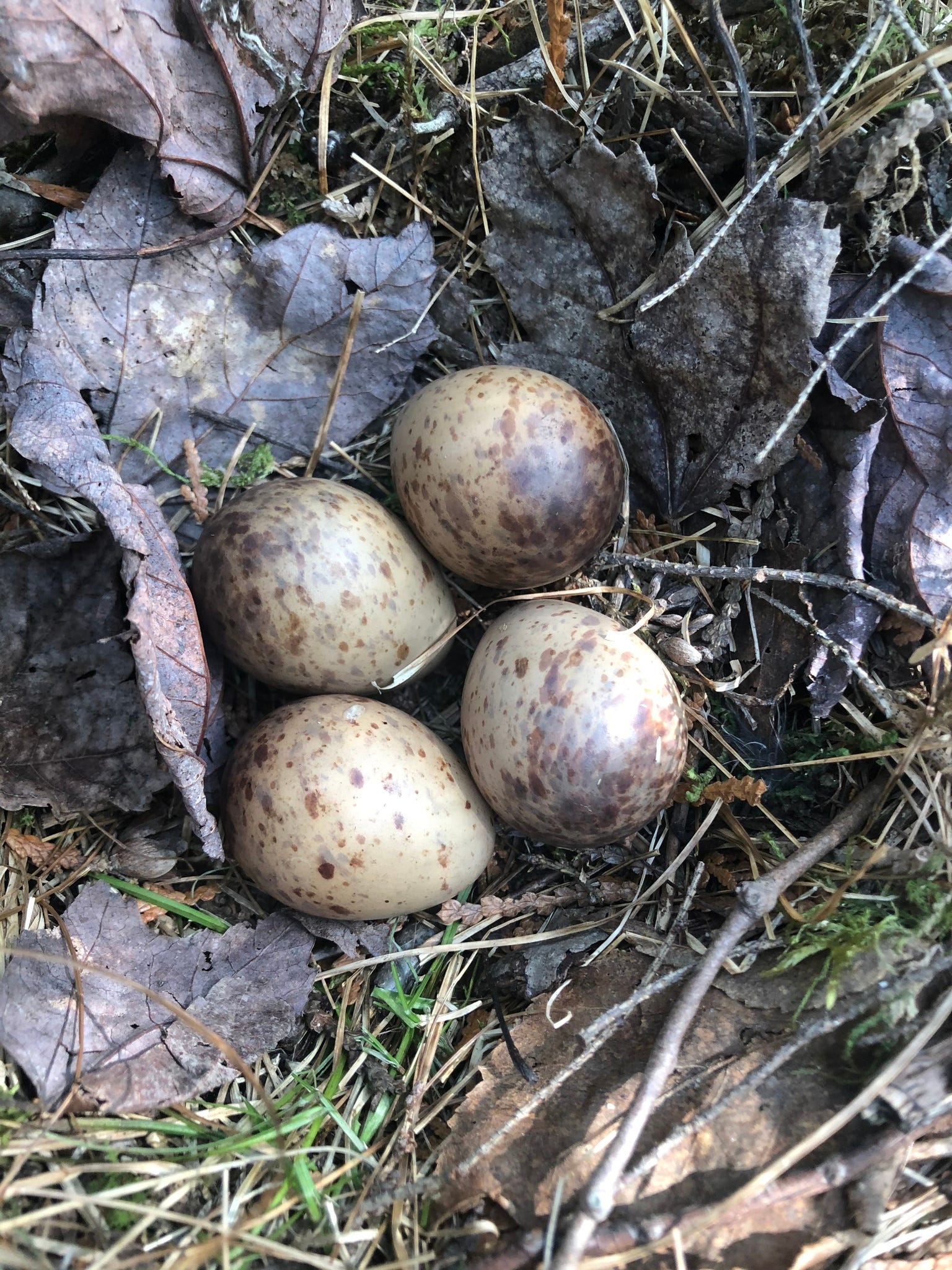
Predators can include mammals, snakes, and raptors. A recent University of Maine study revealed that raptors accounted for most mortality of woodcocks on display grounds in spring, while predation was evenly split with mammals in summer. In fall, mammals accounted for 54% of the mortality, with hunters and raptors adding about 25% each.
Woodcocks leave Maine by October or November and head to forested areas in the Southern US. Radio tagging of woodcock has clarified their routes and destinations. UMaine researchers recently founded the Eastern Woodcock Migration Research Cooperative which has used GPS transmitters to track over 700 individual woodcock on migration.
Hunting Woodcock in Maine and Current Population Trends
Woodcock are considered a prized game bird with rich, earthy flavor. Maine’s Department of Inland Fisheries and Wildlife manages a woodcock hunting season from late September through mid-November with a limit of three birds per day and nine birds per season. Hunting hours begin a half hour before sunrise and end at sunset, and dogs may be used to find and flush birds. The US Fish and Wildlife Service reported an estimated harvest of 9,600 birds in Maine last year, with 4,200 active woodcock hunters and an average harvest of 2.28 birds per hunter.
Although widespread in the Eastern and Central US, woodcock are declining in population and have been listed as a species of Greatest Conservation Need in Maine and several other states. Annual surveys conducted by USFWS since 1968 show overall population declines at 0.74% per year in the eastern part of the country. Habitat loss, particularly in the southern wintering areas, is thought to be a leading factor. Satellite tracking by the UMaine researchers noted above reveals a gradient of migration strategies in terms of timing, routes, and destinations, which suggests a potential for adaptability to changes expected with climate instability. Fortunately, in part because of the woodcock’s value as a game bird, resources for habitat management to benefit breeding as well as continued monitoring and research by federal and state agencies are likely to help buffer woodcock populations.
- Rob Smith
Bravo! I thoroughly enjoy your efforts on behalf of our wild friends and neighbors. We are so lucky to live among them, and to hear from you about them! Thank you.